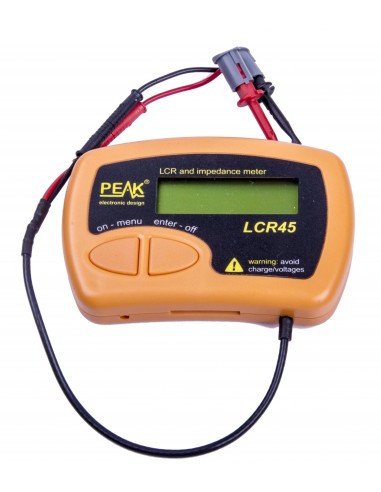
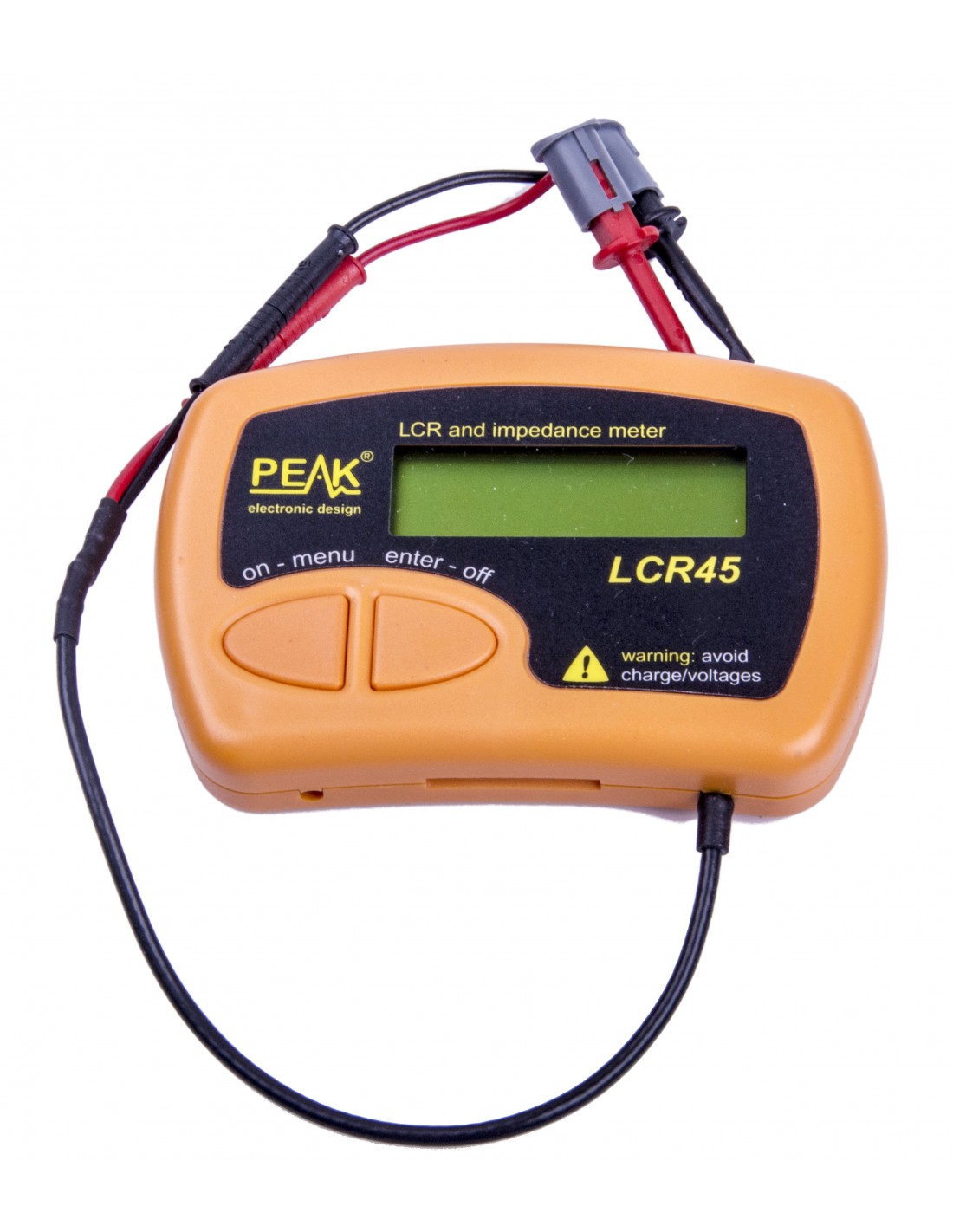
Il LCR45 è una evoluzione del più
popolare LCR40. Ha una risoluzione di misura più fine e analisi
matematica avanzata.
Semplice da usare
Basta collegare il tester al
reoforo che conduce al componente e premere il pulsante di prova. In pochi
secondi, il LCR45 identificherà il tipo di componente (induttore, resistore o
condensatore) insieme con il valore del componente. Le letture sono prese
continuamente, dandovi lo strumento ideale per effettuare regolazioni di
precisione.
Oltre al tipo e valore del componente, il LCR45 può anche
visualizzare i parametri del componente come impedenza complessa, ammettenza
complessa o modulo e fase dell'impedenza.
Inoltre è possibile selezionare le modalità automatica e manuale, sia
per il tipo di componente e la frequenza di prova.
| Technical Specification
Summary (at 20°C) |
 |
LCR45
FAQs |
 |
| |
Can I measure
the impedance of speakers? |
Yes, set the LCR45
to manual inductance mode and a fixed frequency of 1kHz or 15kHz.
You can see the inductance, resistance, total impedance and phase of
the impedance. |
|
| When testing
speakers at 15kHz, I can hear a low frequency buzz from the speaker,
not the 15kHz I've selected. Why? |
The LCR45 uses
"bursts" of test signals, it is these "bursts" that you can
hear. During each burst, the LCR45 is
using the test frequency you've selected. |
| Can I measure
arbitrary impedances rather than just components? |
Yes. If the LCR45
has difficulty selecting the best mode and frequency then you can
switch to a manual mode and test frequency to display the detailed
impedance. |
| Can I use this
in-circuit? |
No, it is not
recommended for in-circuit use. Other component interactions can
cause misleading results and damage may result from unexpected
charged devices. |
| Is the LCR45
better than the LCR40 for low inductances? |
Yes. The use of a
finer resolution ADC provides significantly finer measurements when
measuring below 1µH. |
| Is the LCR45
calibrated? |
Yes. Every LCR45
is individually calibrated to standards that are traceable to
international standards. |
| What probes are
included? |
Our universal gold
plated hook probes (removable). |
| | |
|
Parameter
|
Min
|
Typ
|
Max
|
Note
|
|
Resistance |
range |
0? |
|
2M? |
|
|
resolution |
0.1 ? |
0.2? |
|
|
|
accuracy |
Typically ±1.0% ±0.6
? |
1,2,6 |
|
Capacitance |
range |
0pF |
|
10,000µF |
|
|
resolution |
0.1pF |
0.2pF |
|
|
|
accuracy |
Typically ±1.5%
±0.6pF |
1,2,5 |
|
Inductance |
range |
0µH |
|
10H |
|
|
resolution |
0.1µH |
0.2µH |
|
|
|
accuracy |
Typically ±1.5%
±0.6µH |
1,2,4 |
|
Passive
Component
Impedance |
Re & Im |
Typically ±1.5% ±10
LSD |
4,5,6 |
|
Magnitude |
Typically ±1.5% ±10
LSD |
4,5,6 |
|
Phase |
Typically ±5° |
4,5,6 |
|
Measurement Sample
Rate |
0.5Hz |
1.5Hz |
2Hz |
|
|
Peak test voltage (across
O/C) |
-1.05V |
|
+1.05V |
|
|
Peak test current (thru
S/C) |
-3.25mA |
|
+3.25mA |
|
|
Test frequency
accuracy |
1kHz |
Typically ±0.5% |
|
|
14.9254kHz |
7 |
|
200kHz |
|
|
Sine purity |
Typically -60dB 3rd harmonic |
|
|
Operating temperature
range |
10°C |
|
40°C |
3 |
| |
50°F |
|
104°F |
|
|
Battery operating voltage |
8.5V |
|
13V |
| |